Tiny Fish and Ace Aquatec: Making every fish count
A small start-up has joined forces with a leading aquaculture firm to create value from under-sized farmed salmon that are unfit for continued growth. Welcome to the world of Tiny Fish and Ace Aquatec!
Vision. Technology. Partnership.
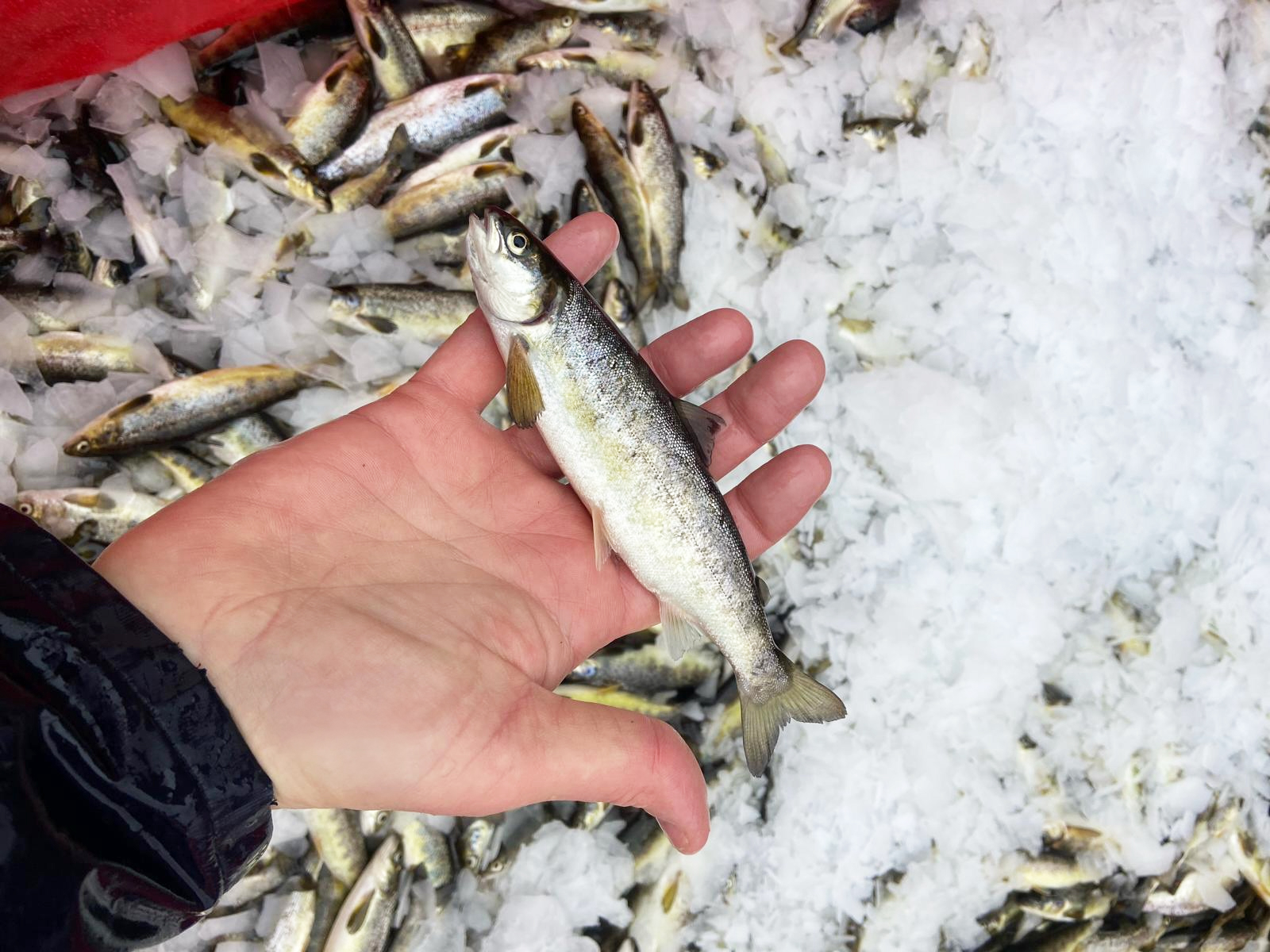
Not every salmon reared at Scotland’s aquaculture freshwater hatcheries makes it to the dinner table – an estimated 10% simply don’t grow to a viable size to be transferred to sea. And for Teresa Garzon and Jarl van den Berg, that was a challenge that had to be tackled.
Wasted fish
Until recently, the standard practice in the industry has been to dispatch under-sized salmon using chemical anaesthesia and then dispose of them through tightly regulated processes such as anaerobic digestion or incineration. “To remove small but otherwise healthy fish and not make use of them is quite drastic from both a fish health and a production point of view,” says Teresa. “It was something we discussed often because we felt it wasn’t right.”

Sharing ideas
As well as working in Scotland’s aquaculture industry, Teresa and Jarl are a couple, and so the discussion was one that continued at home. They wondered if there was a market for the smaller fish, perhaps in pet food, feeding animals in zoos, or as snacks and dishes that could be served up in bars and restaurants, or sold in shops.
The first challenge had been to establish a more humane method of culling the fish that would also leave them safe for consumption — a problem Dundee-based Ace Aquatec had already solved. The business had pioneered an in-water stunning system for larger fish and, after teaming up with Tiny Fish (by this stage, a limited company set up by Jarl in Oban), a compact version— the A-HCS® — was deployed for small fish.

A more humane and cost-effective method
Cost benefits
“The system has a 100% stun rate and can process two tonnes of fish per hour more humanely and efficiently than any other method,” says Tara McGregor-Woodhams, Chief Sales and Marketing Officer at Ace Aquatec. “And the system is more cost-effective than using chemical treatments, making it a more environmentally responsible option.
More humane
“Salmon farmers care deeply about welfare,” adds Tara. “When we visited hatcheries, the staff were upset by the old chemical method. Our system was a game changer for them. Then Teresa and Jarl worked incredibly hard to get the major producers on board. Once the first adopters came in, there was a domino effect and others quickly followed.”
Labour savings
“There’s also the labour side,” says Jarl. “With chemical methods, the process is time-consuming and labour-intensive, requiring multiple handling and tank management steps. The Ace Aquatec system is much quicker, cleaner, and more humane. Many hatcheries now have their own Ace Aquatec machines, so we co-ordinate the pickup, processing, and distribution.
Growing demand
“Tiny Fish is a company aiming to be a sustainable business model that can be copied,” adds Jarl. “Our expectation is for our selling price to reach a similar price to small trout or wild-caught fish, at around £4 per kilo. We’ve had a lot of support from hatcheries making the product available, and they’ve also supported some direct costs, such as transport and freezing. After a year and a half, we’re seeing recurring orders and a customer pool starting to form. It’s encouraging.”
The biggest demand at present is for using the fish in pet food. But zoos are also a strong potential market. For instance, Tiny Fish has been working with Auchingarrich Wildlife and Adventure Park in Perthshire, providing salmon to animals such as Asian short-claw otters, kookaburra and meerkats. The residents are thriving on the closely-monitored nutritional benefits of the fresh fish, which are frozen immediately after the stunning process – and offer a much better option than buying fish caught in the wild.
International markets and scaling up
“Collaboration with food processing companies and fish retailers would also be great,” says Teresa. “And interest is growing overseas – for instance, we received good feedback after exporting some Tiny Fish to Dubai.”
“We need two or three large customers taking routine orders,” says Jarl, looking to the bigger picture. “It’s very scalable so, long term, we’d like to expand the model to Chile and Norway and see the practice adopted globally.”
Tara believes that the global demand for protein means the potential is huge. “Aside from vegetables, fish is one of the lowest-carbon protein sources available. From an environmental perspective, it makes no sense to cut down rainforests to grow feed for cattle when fish offer such efficient nutrition. Omega-3s are vital, and aquaculture can provide that sustainably.”
“These fish are healthy, just small,” adds Jarl. “Our mission is to make every fish count.”

“Collaborate early”
Teresa’s advice to businesses embracing a circular approach
“Find like-minded people and collaborate early on, before you’re in a position to deliver.
Keep pushing forward – and don’t give up on long-term targets.”