Bioeconomy
Scotland's bioeconomy includes the parts of the economy that use renewable biological resources from land, water, and air such as crops, forests, fish, animals, and micro-organisms and the conversion of these resources into products such as food, feed, materials, and energy for economic purposes.
In summary
A circular bioeconomy helps organisations make better use of renewable biological resources by keeping materials and nutrients in use for as long as possible. This page highlights how circular approaches can create value from biological resources, reduce waste and support sustainable economic growth.
What this means for you
Adopting circular bioeconomy principles can help your organisation unlock value from by-products, improve resource efficiency, strengthen resilience and create new commercial opportunities.
What to do next
- Identify opportunities to maximise the value of biological resources and by-products.
- Explore partnerships and collaborations to support innovation and growth.
- Access research, case studies and support to help implement circular bioeconomy practices.
A 2024 Scottish Government study researching the importance of natural capital to the Scottish economy found that, in 2019, Scotland’s nature‑dependent industries, excluding non-renewable industries such as oil and gas, generated around £40 billion in economic output - about 14.4% of the country’s total. This includes agriculture, fishing and aquaculture, forestry and wood products, water and sewage services, drinks production, and electricity generation.
Since 2015, Zero Waste Scotland has played a key role in supporting the development of a circular bioeconomy, identifying opportunities to extract greater value from bio‑based wastes and by‑products. By creating interest among producers and off-takers, and by facilitating the right connections, support and expertise, it has helped accelerate the development and delivery of more sustainable, commercially viable solutions.
What is a circular bioeconomy cycle?
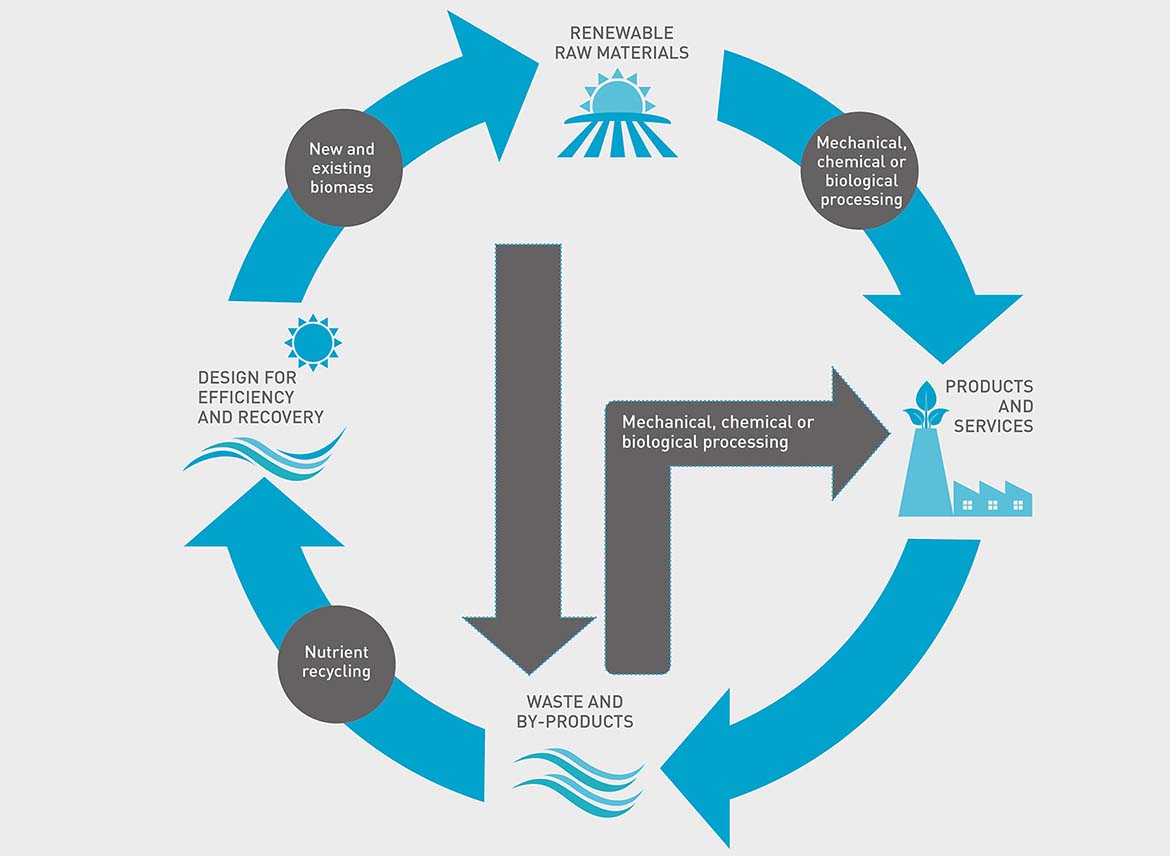
The circular bioeconomy applies circular economy principles to the use of biological resources, ensuring they are managed efficiently throughout the entire value chain. At every stage - from design and production to processing, use and end‑of‑life - materials are kept at their highest possible value for as long as possible. When products can no longer be reused or repurposed, their nutrients are returned to the biosphere.
The diagram below illustrates a circular bioeconomy cycle, showing how biological resources move through a renewable, regenerative system. It presents a loop of interconnected stages focused on minimising waste and maximising value through efficient use, recovery and recycling of biomass.
Driving Scotland’s circular bioeconomy forward
If you're involved in the bioeconomy in Scotland, especially in leadership or strategic roles, this is a prime time to:
- Embed circular economy principles throughout the entire value chain - from design and production to use, reuse and valorisation - to minimise waste and maximise the value of by‑products.
- Collaborate across government, industry, academia and support agencies to share knowledge, access funding, build capability and identify new partnership opportunities.
- Form strategic partnerships to scale solutions, strengthen feedstock and market security, and enhance the credibility of funding applications and emerging business models.
- Champion and publicise innovation to build visibility, credibility and confidence among funders, partners and wider stakeholders.

Social and environmental impact
Beyond their significant economic contribution, nature‑dependent industries also play a vital role in sustaining Scotland’s social wellbeing and environmental health. Supporting a circular bioeconomy in Scotland can further enhance its positive impact on society, the economy, and the environment while helping to address pressing challenges such as climate change and biodiversity loss.
Social
The Importance of Natural Capital to the Scottish Economy study published by the Scottish Government in 2024 estimated that nature-dependent sectors in Scotland such as agriculture, fishing and aquaculture or forestry and wood products (excluding non-renewable sectors) have supported around 261,000 jobs in 2019. Additionally, the Scottish Government allocated up to £100 million through the Green Jobs Fund in 2022 to address skills challenges and opportunities, supporting sectors including the bioeconomy.
Environment
Bioeconomy-based projects, such as peatland restoration, sustainable woodland management, Sustainable Agriculture Practices and the implementation of Bioenergy with Carbon Capture and Storage (BECCS) technologies, contribute to Scotland’s biodiversity preservation and Green House Gas (GHG) emissions reduction.
Read our reports
Browse useful reports that highlight opportunities, challenges, and innovations in circular bioeconomy.
Explore further evidence
Access a selection of recommended strategies and reports offering useful insights and research on the circular bioeconomy.
SEFARI Circular Bioeconomy Opportunities
The Circular Bioeconomy Opportunities Valorising Agricultural Wastes and Co-Products report looks at ways to make better use of agricultural wastes and by‑products in Scotland.
Circular Bioeconomy Opportunities Valorising Agricultural Wastes and Co-Products
European Commission Bioeconomy Strategy
The Strategy for a Competitive and Sustainable EU Bioeconomy explains the EU’s plan to use biological resources in a more sustainable way.
SDI National Plan for Industrial Biotechnology
The National Plan for Industrial Biotechnology sets out Scotland’s plans for growing its industrial biotechnology sector.
Support from external organisations
Connect with organisations that provide expertise, training, and research in circular bioeconomy.