Celtic Renewables: We are in demand
A pioneering process that turns whisky residues and rejected potatoes into green chemicals is a perfect fit for consumers demanding greener, more sustainable products. The challenge for Celtic Renewables is scaling up. And it’s a challenge the Scottish Government has recognised with funding to support the required investment.
Innovation. Investment. Scale.
Celtic Renewables is in demand – customers can’t get enough of its revolutionary green chemicals. “Nobody is producing bio-acetone and bio-butanol from by-products and waste on the scale we are, so it’s fair to say we’re the world leaders in this,” says Marketing & Communications Lead Toni McDonald. “But it’s all about scaling up for us because our refinery can produce 400 tonnes, but we have significantly higher demand from companies in our markets.”
As challenges go, it’s a good one to have. And the reason for the demand is a growing realisation among commercial customers that, as well as meeting their Scope Three targets, they need to address increasing consumer demand for greener products.
This is the future
“I've been in the chemical industry for nearly four decades, and this is the future,” says Bettina Brierley, Chief Commercial Officer at Celtic Renewables. “We can’t keep relying on fossil fuels for everything. They should be used only where they’re truly needed, and there is a growing realisation of this.”


Research discovery
Celtic Renewables developed when the company’s founder, Martin Tangney, opened the Biofuel Research Centre at Edinburgh Napier University in 2007. After filing patents for the Centre’s work, Celtic Renewables was formed in 2012. “Essentially, Martin and his colleagues reinvented the process for the production of acetone, butanol and ethanol (ABE),” says Toni. “ABE fermentation has been around for decades, but it used crop-based feedstocks – often competing with food. What we do is create green chemicals from by-products and waste, such as reject potatoes that are neither fit for human nor animal consumption, and whisky by-products. We're offering a direct replacement for fossil fuel products.”
The chemicals market
Backed by significant private and public investment, Celtic Renewables has built scalable technology that produces low-carbon, bio-based chemicals from industrial by-products and waste, working with markets including pharmaceuticals, cosmetics and personal care. “Our bio-based chemicals reduce carbon emissions by over 60%,” says Toni.

Two sets of customers
As with many businesses in the circular economy, Celtic Renewables works with two distinct sets of customers – the organisations that are seeking solutions for waste and by-products, and the companies that want to buy green chemicals. And ESG imperatives and changes in consumer behaviour are helping to motivate both.


Educational storytelling
“Our brand story is designed to show people how much of their daily life is currently dependent on fossil fuel-based chemicals – and how everyday products such as medicines, cleaning sprays and cosmetics could be made more sustainably with our green chemicals, reducing the carbon impact significantly,” says Toni.
“Most consumers have no idea that they’re putting crude oil products on their skin every day,” adds Bettina. “Education is the missing link in the sustainability story – we need to bring people along and help them to understand what they’re buying. The challenge is pricing. Everyone knows they have to move towards sustainability, but the truth is that green products will often cost a bit more at first. Fossil fuels have had decades to optimise – we’re just getting started.”
Scaling up
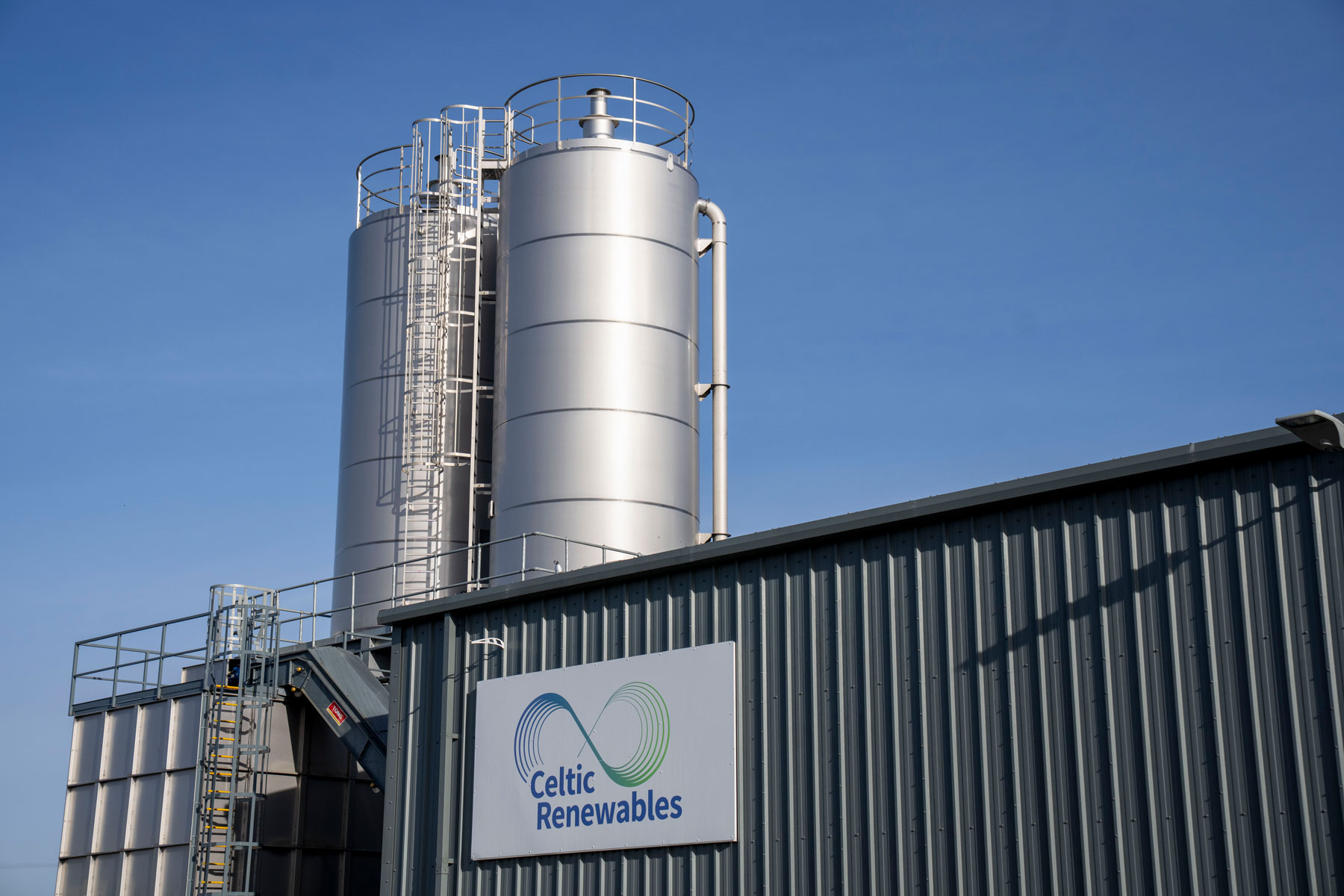
After securing £20m of funding from Scottish Enterprise in 2020, Celtic Renewables set to work on constructing its extensive Caledon Green production facility at Grangemouth, which became commercially active in 2023 and now supports more than 60 employees. “There have been challenges taking the process from lab to full plant scale,” says Toni. “But now that we've developed all of the relevant IP, we can take our learnings and roll them out across future sites.”

Major funding
Importantly, in December 2025, it was then announced that the Scottish Government was providing £6.23m of funding for pre-construction work at a second, larger Celtic Renewables bio-refinery at Grangemouth, expected to create more than 140 jobs. There are also plans for two more sites to follow elsewhere.


Licensing the technology
“We can never stand still,” says Bettina. “Scaling up is the priority because people take you more seriously when you have volume and are able to show you can deliver at a high rate of production. But even three more plants is a relatively small drop in the market, so the model then is to licence the technology.”
Fresh innovations
Another big focus is continued R&D and fresh innovations. “We’re constantly exploring new feedstocks to stay adaptable and innovative,” says Toni. “We’re researching everything from cardboard to dairy residues and recovered cellulose.”
“It’s the circularity of our model that is so powerful,” says Bettina. “We take waste and by-products from food, drink and agriculture industries and, we turn it into valuable chemicals, and then our by-products are used to create bio-gas. It’s a full loop that leaves virtually nothing behind.”

“Each setback taught us something”
What’s Toni’s advice to any organisation wishing to embrace the circular economy?
“You need to be persistent. That means being ready to fail but not letting it stop you. We didn’t get everything right, but each setback taught us something vital. If you keep going, it will work out well in the end.”