
ReSet Scenery: Re-setting the scene in the creative industries
A not-for-profit enterprise in Glasgow is transforming the way that film, theatre and events companies manage their sets. As Simon Cook of ReSet Scenery demonstrates, reusing production materials makes financial as well as environmental sense.
Innovation. Redesign. Value.
“People focus on the environmental benefits of the circular economy, which are of course very important,” says Simon Cook. “But there’s a huge under‑recognised benefit which is the collective creativity this movement is generating. Circularity is driving innovation in methods, materials and modularity.”
That innovative approach to production resources is very much the sweet spot for Simon and his co-founder of Glasgow-based ReSet Scenery, Matthew Doolan. “Matt and I have worked in the creative industries most of our lives,” says Simon. “We kept building the same foundational items for theatre, film and events, only to see them used for a few weeks, or even a few hours, and then thrown in a skip.”
Simon points to the BAFTA albert Accelerate 2025 report which calculates that 800,000 of post-production materials go to waste in the UK every year. Furthermore, he believes this only represents “the tip of the material waste iceberg” as it doesn’t include all screen production, or any stage or event production.
Having grown increasingly frustrated at waste levels long before that report came out, the pair tried to create a peer-to-peer sharing network, but the finishing dates for productions rarely matched other people’s start dates, and it became clear they needed somewhere to store scenery in between.
From leaky roofs to lasting impact
“We were given a small space at a seaweed processing place in Port Dundas, Glasgow,” says Simon. “It was free but very basic, with holes in the roof. On the plus side, it gave us somewhere to prove that a circular marketplace for post-production scenery could work.”
Eight years on from the launch of ReSet Scenery as a Community Interest Company, the duo’s persistence has paid off, with a steady increase in revenue and successfully securing Multi Year Funding from Creative Scotland allowing them both to work within the business full-time.
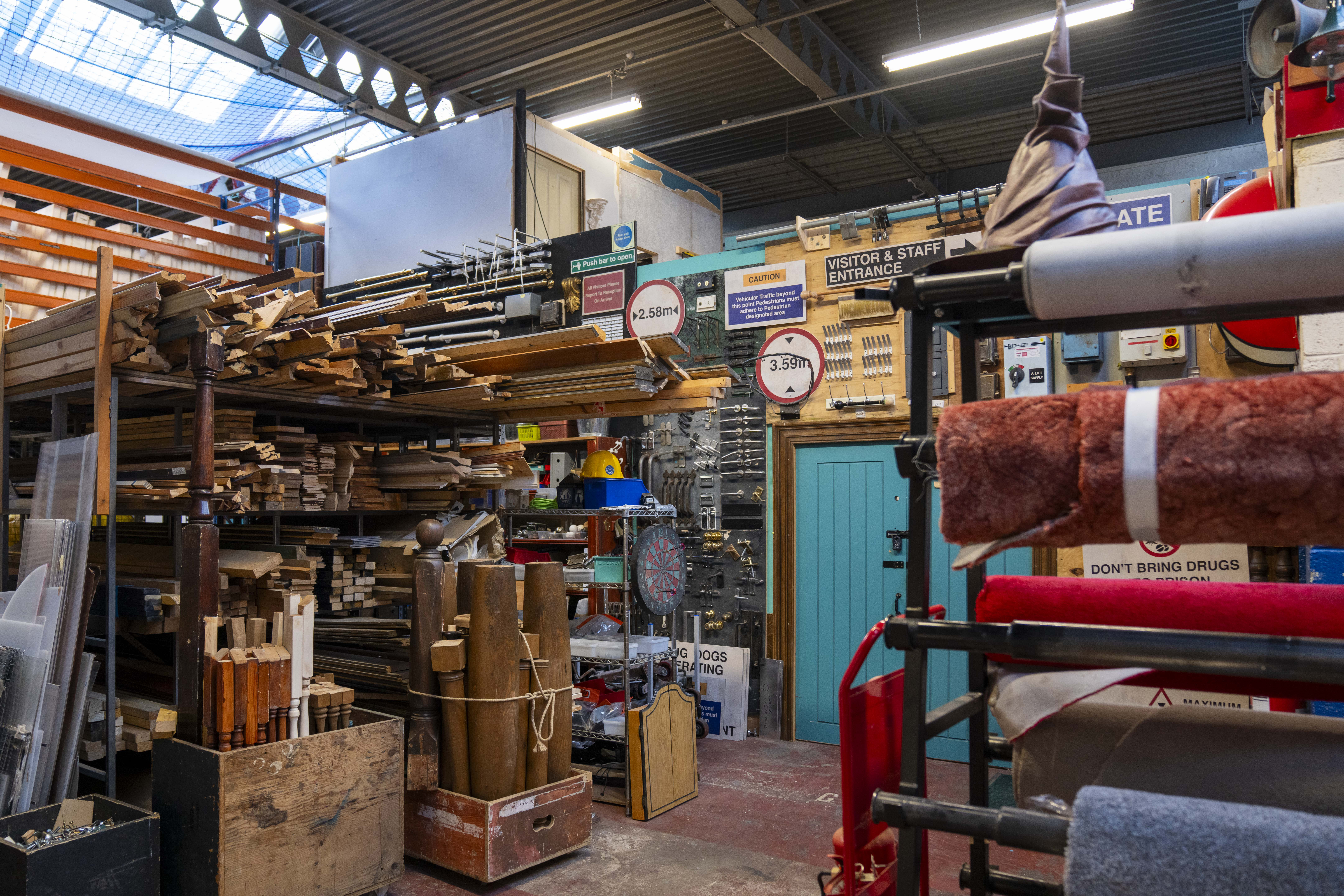
They now have a watertight warehouse a little further north in the city, with 7,500sq ft of capacity holding over 200 tons of stock for sale or rental. The stock is collected by offering a production clearance service, and carefully breaking materials down for reuse scenery that can be hired or purchased by other clients.
“Our aim is to grow to 50-75,000sq ft to support all the activity in Scotland,” says Simon. “But that wouldn’t necessarily be in one location. A series of distribution hubs would be a good model that would allow us to localise activity and reduce transport miles. Our core strength is the simplicity of the intervention – the model is infinitely scalable.”

Making sustainable scenery appealing and accessible
ReSet Scenery’s client base spans everything from Amazon, Apple and Netflix to national TV, theatres, and much smaller requirements from community groups and schools. “As audiences demand greener production standards, our main appeal to the major screen productions is focused around social responsibility and brand sensitivity,” says Simon. “Meanwhile, mid‑tier organisations such as national and regional theatres are much more open to the budget savings they can make. On average, the scenery we put back into circulation is about 50-60% cheaper. And those savings really take hold with the smaller companies. For them, the cost benefits are transformative and give them access to things they couldn’t otherwise afford.”


Innovating for circularity starts with design
But one thing that unites all these customers is that the scenery they use is generally made from the same materials – it’s just the scale that varies. “We’re trying to tackle the creative industries’ problems at both ends by reusing materials and encouraging better design,” says Simon. “Scenery is built to be lightweight and adaptable but, once a production ends, it’s almost impossible to separate the materials for reuse.
Metal screws and nails are the biggest barrier so we’ve partnered with Beck Fastening, creators of LIGNOLOC wooden nails. That has enabled us to make a huge increase in recovery rates of up to 80% of timber. We’re also working with a set fabricator who’s developing a process for using recycled paper pulp as a replacement for PVC, which is another problematic but widespread material.”
Measuring the impact and moving forward
And for clients keen to measure the impact of working with ReSet Scenery, the company provides an embodied carbon and weight report showing what’s been diverted from landfill. There’s also an outreach element with the company offering free scenery to schools. “It’s important because students then have the chance to learn about circular practices and adopt them early on.”
As with many other businesses in the circular economy, Simon and Matt are encouraged by the feeling that they’re moving with the prevailing winds of change. As more people in their industry become interested in reuse, supply and demand increases, and costs become more competitive.
“Audience pressure is definitely changing the landscape, and sustainability is becoming part of the decision-making process,” says Simon. “The Circular Economy Act is a major game‑changer. Once fully implemented and enforced, I believe it will create standards in the same way that health and safety regulations have.”

What’s Simon’s advice to businesses keen to embrace circular principles?
Persistence is required. To make changes and do things differently is always difficult. But you have to think long term. Sometimes we have to give ourselves a kick and remember that we are making a difference, and that there’s genuine value to it.