
MiAlgae: Circularity brings a competitive advantage
A chance observation at sea inspired an ambitious plan to supply sustainable omega-3s to the aquaculture and pet food sectors. And now, 10 years on, Edinburgh-based MiAlgae is scaling up – big time.
Innovation. Purpose. Ambition.
Douglas Martin was thinking about starting a business. But he wanted it to be one with a “good heart” that delivered impact at scale – and he found his inspiration out at sea. While working in the offshore wind industry, Douglas encountered a massive algal bloom, and it set him wondering. If excess nutrients could create problematic algae in the wild, could he use a nutrient source in a lab to grow ‘good’ algae?
Douglas went on to launch MiAlgae in 2016 while studying for an MSc in Synthetic Biology and Biotechnology at the University of Edinburgh. By this point he was confident that he could grow omega-3-rich microalgae commercially, selling it to fish farms as a sustainable alternative to feeding the salmon with wild-caught fish.
“I’d always been interested in our oceans, food systems and aquaculture, and knew there was a need for good, sustainable ingredients,” says Douglas. “At the same time, I wanted to start a company that made money while doing some good in the world.”

“Making a positive difference is important to everybody that works here”
Supported by funding from friends and family, Douglas recruited bioprocessing expert Shreekanth Ramananthan and microbiology expert Julian Pietrzyk. “From the very beginning, the model was based on giving value to a co-product while replacing a traditional extractive omega-3 supply chain that is effectively pillaging the oceans,” says Julian. “It was this that drew myself, Shreekanth, and many of our later hires to the business. Making a positive difference is important to everybody that works here – and our investors.
“Things took off when we landed on the idea that microalgae could consume whisky co-products and produce a fermentation product that is rich in omega-3s. We then went through numerous rounds of investment and grant funding, moving from pilot and demonstration scale to where we are now – commercial manufacturing.”
Fermentation systems can be very complex but, with limited funds initially available, the MiAlgae team had to keep the process streamlined and modular – a discipline and strategy that is now paying dividends as they scale up. Production once took place at Balfron near Stirling, with the company’s lab based at Heriot-Watt University in Edinburgh. However, in December 2025, construction work started on a major new facility at Grangemouth, set to open in Spring 2026.
“Moving from a demonstrator to full commercial manufacturing is a huge step change for us,” says Julian. “It’s exciting and terrifying at the same time. The new site gives us increased automation and capacity – things we’ve been working towards for many years. And the model has been designed to be replicated, ideally as close to feedstock sources as possible. We see Grangemouth as a blueprint rather than a one-off.”


Moving into pet food – and health supplements for human consumption
Aquaculture remains the focus of the business, as it currently drives the volume demand for omega-3s. But other opportunities are supporting growth. “We also recognised that there was strong demand in other industries and Omega-3s are essential to most animals,” says Julian. “We have seen strong market pull from the pet food industry and importantly for us, it’s a market that moves quickly and grabs cutting-edge innovations such as ours with both hands. Aquaculture remains a long-term strategic market, but at the moment we’re leaning into the wonderful world of pet food.”
In the meantime, what is it about MiAlgae that appeals to existing customers? “Firstly, there’s a strong Scottish story there,” says Julian. “We’re bringing together the whisky and salmon industries – and that narrative is important for many of our customers. But beyond that, we have a strong carbon story. The process is highly sustainable and we have the credentials to back that up. Traceability is important as well, particularly the fact that we manufacture locally. And in terms of the product itself, we offer consistency, high quality and stable pricing. You simply don’t get that with traditional fish oil – the price fluctuates according to factors such as the weather, and Omega-3 levels can be very inconsistent.”

No shortage of feedstock from the whisky distilleries
Another advantage of the MiAlgae approach is that there is no shortage of feedstock. “For every litre of whisky produced in Scotland, around 15 litres of co-product are created,” says Julian. “We deal directly with the distillers. Each distillery has its own approach to handling co-products, so we have to develop bespoke ways of working with them. But that’s fine. Scotland provides a unique and abundant feedstock base, and there’s plenty to go around, which makes it an ideal location for us.”
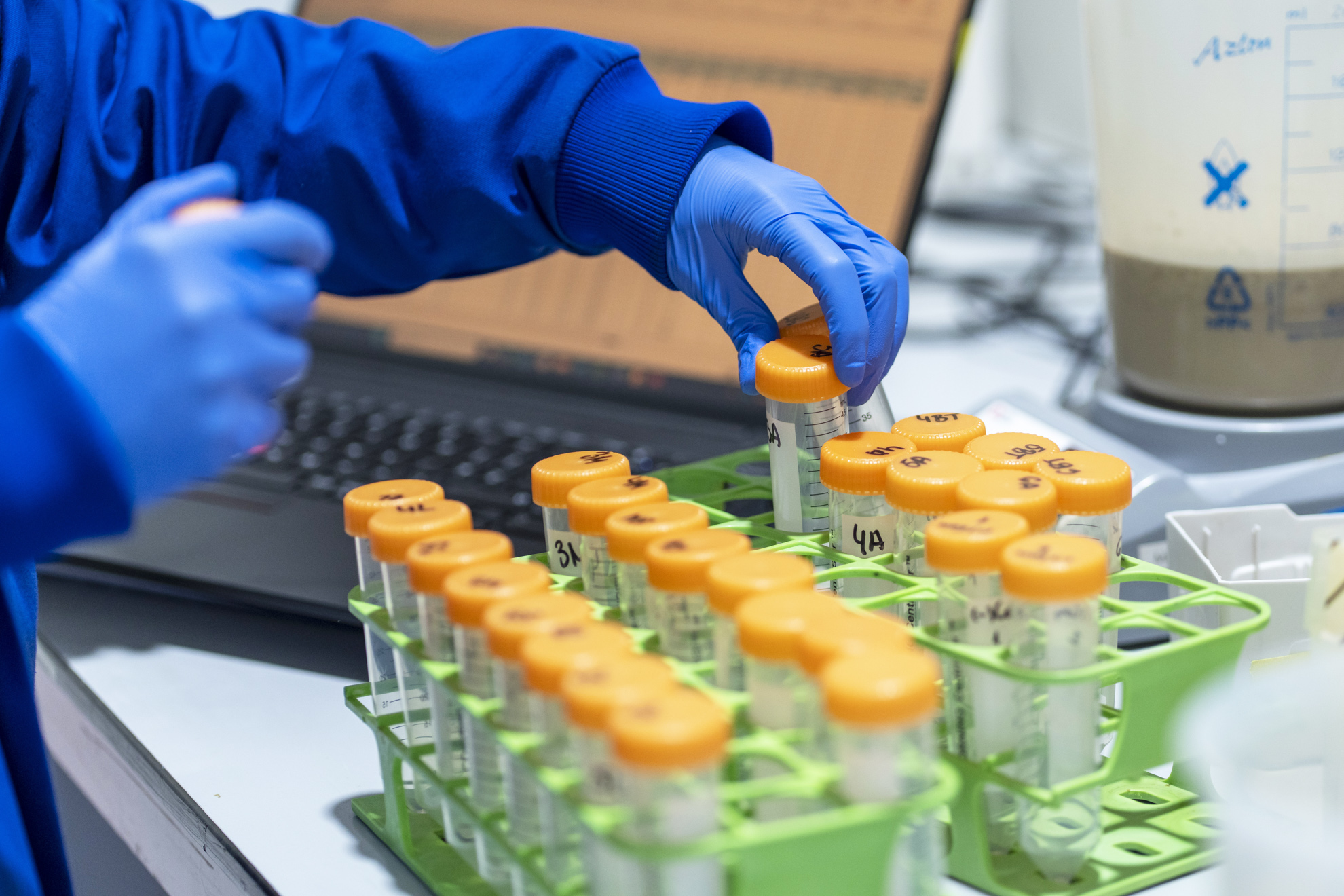
Interestingly, the variety of whisky styles across Scotland has created a challenge. “A big part of our research and development is optimising inconsistent co-products to ensure that we get the same end result with the final product,” says Development Scientist Jake Wiseman.
The work in the lab is critical to ensuring that the manufacturing process goes smoothly – and that more innovations can be discovered. Jake’s colleague, R&D Scientist Jess Atkinson, tells us with relish about the company’s ‘blue sky sprint days’ – “where the scientists are let loose in the lab and allowed to explore any ideas they have”.


