Kenoteq: Revolutionary brickwork
The humble brick has barely changed in a thousand years – but now the K-BRIQ, made in East Lothian, presents a recycled, low-carbon alternative, and a compelling business case.
Disruption. Growth. Vision.
“From old brick and gravel, to stone, concrete and mortar, there’s so much aggregate taken from construction and demolition sites,” says Dr Sam Chapman, Executive Director of Kenoteq. “We call it ‘waste’ but it should be a resource. Why not take all that aggregate and turn it into a brick? It’s a product that has barely changed in a thousand years. But we need the circular economy, we need low-carbon innovation, and we need a more sustainable, efficient approach to manufacturing. We’re doing all three of those things with the K-BRIQ.”
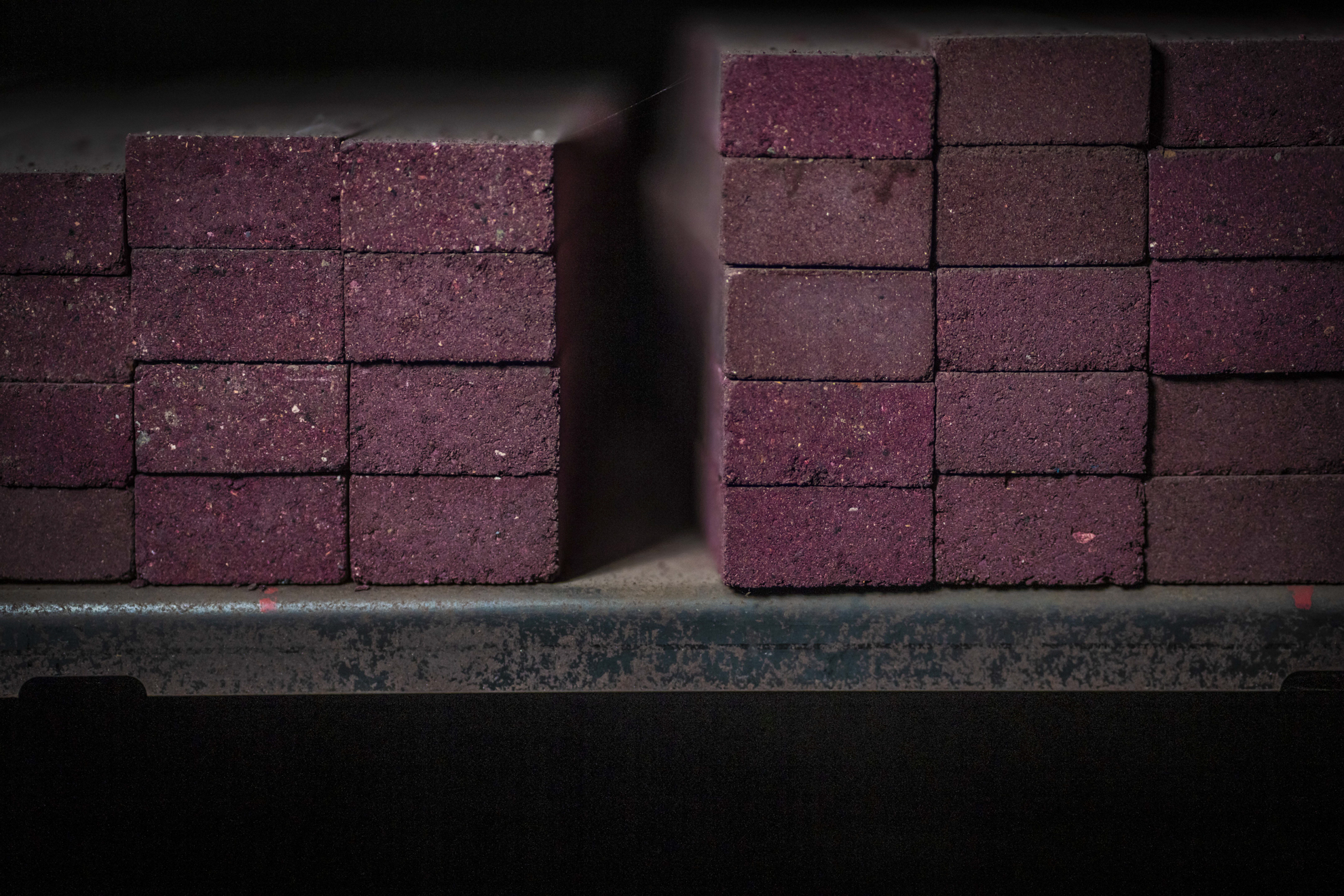
Manufactured in Kenoteq’s East Lothian factory, the K-BRIQ (made from 95% recycled materials) doesn’t undergo the high-energy firing process of traditional clay bricks, and therefore carries less than 5% of the embodied carbon. But it’s also a thing of beauty, available in a range of colours such as Chapman Burnt Orange, Gullane Cyan and Heriot Mustard. “They’re our babies and we love them,” says Sam. “And once people see the product, they love them too.”
The genesis of the K-BRIQ was a discussion at Heriot-Watt University between Sam’s co-founder, Professor Gabriela Medero, and David Hamilton, co-owner of Hamilton Waste & Recycling. “They were talking about what they could do with all the recycled materials that Hamilton was collecting,” says Sam. “I was one of Gabi’s students and she realised that the solution could be a brick.”

Creating a brand to break old habits
Sam and Gabi founded Kenoteq in 2019 – the name comes from the Greek words for innovation and technology. “We also wanted to give the brick a name,” says Sam. “With the K-BRIQ, we’ve created a brand, which isn’t common in the brick world.”
The company now employs seven people. “I originally took on the CEO role until we could bring on a more experienced leader,” says Sam. “And we've been steadily growing the team through people with greater knowledge of construction and production. I'm now in a sales and marketing role – I go out and tell the story.”
But there have been many challenges. “The biggest has been making headway in a very conservative industry,” says Sam. “Achieving certification for a product made from recycled content that doesn’t easily fit into a British Standards box has been a long, frustrating process. There’s been no clear timeline and it’s felt chaotic at times. The construction industry is the biggest impactor of carbon and waste, and yet I believe it’s a hard industry to innovate in. It’s full of risk aversion, red tape and entrenched habits. And from the architect to the contractor, there are so many people to convince across the supply chain. However, now that we have several exciting projects under our belt, people are wanting to be part of the story, which is a great feeling for us.”


Economies of scale will drive down our price
At the time of writing, the K-BRIQ had already saved well over 100 metric tons of greenhouse gas emissions. “And unlike nearly all other masonry products on the market, the K-BRIQ delivers an ultra-low embodied carbon figure,” says Sam. “We also have one of the highest inputs of recycled content on the market, targeting both net zero carbon ambitions and circular economy/material re-use targets.”
But as with many pioneering products, the K-BRIQ is currently seen as a premium product that’s more likely to appear in a feature wall designed by a sustainability-minded architect than as part of a large construction scheme. This is predominantly down to economies of scale and the circular economy still developing – as Kenoteq ramps up production, the price will drop because the process of making the K-BRIQ is not inherently expensive. As a result, Kenoteq is raising a fresh round of investment to expand production capacity up to around four million bricks a year.

We intend to replicate our operations worldwide
“That's a huge deal for us but a tiny fraction of the annual 2.5 billion demand for bricks in the UK – typical plants produce 50-80 million units a year,” says Sam. “. However, all of the big manufacturers are now also looking at low-carbon alternatives, and we’re perhaps more nimble. The intention is to start replicating our facilities around the globe, following the recyclers and the waste material. Standard brick prices will steadily rise because of fossil fuel dynamics and carbon levies, while our price can go down.”
Sam’s willingness to put himself out there has been key to the success of Kenoteq – whether that’s forging friendships with curious architects, talking to traditional brickmakers or securing funding and other forms of assistance. “The support from Zero Waste Scotland and Scottish Enterprise has been huge,” says Sam. “And then there’s Heriot-Watt University – without the support and access to their facilities and wider spin-out support, everything would have been so much more difficult.” Investors have included the Hamilton family, and the owners of construction company BHC. “Investment from within the industry is ideal,” adds Sam. “They really get what we’re doing.”

“Make yourself some allies”
Sam’s advice for anyone wanting to shake up their industry through circular thinking:
“I've seen a few companies that have gone down the route of ‘look how great we are – everything else before us was rubbish’. But that’s not helpful to anyone. Make yourself some allies. Come into this with open arms and an open mind, and learn from what's gone before.”